What the Timeline Shows
52 Ancestors in 52 Weeks - Week 41
A Line of Daughters
When I first saw this week's 52 Ancestors prompt, “What the Timeline Shows,” I didn’t feel very inspired. Timelines are useful genealogy tools, but they don't exactly make my heart go pitter-patter.
Then I thought about my Daughters of the American Revolution lineage.
My Revolutionary War Patriot is George Douglass, who lived in Camden District, South Carolina. His recognized patriotic service wasn't military service. George provided goods for Continental use during the Revolution. Records later awarded his estate for the goods and supplies he had furnished to the Revolutionary cause.
George died sometime after June 1784. His son, also named George Douglass, remained in South Carolina and died in York County in 1816.
And then something interesting happens in my timeline.
The Daughters Take Over
The younger George Douglass had a daughter named Mary Douglass, born about 1795 in South Carolina. Mary married William Turner, and it is through her that my line continues.
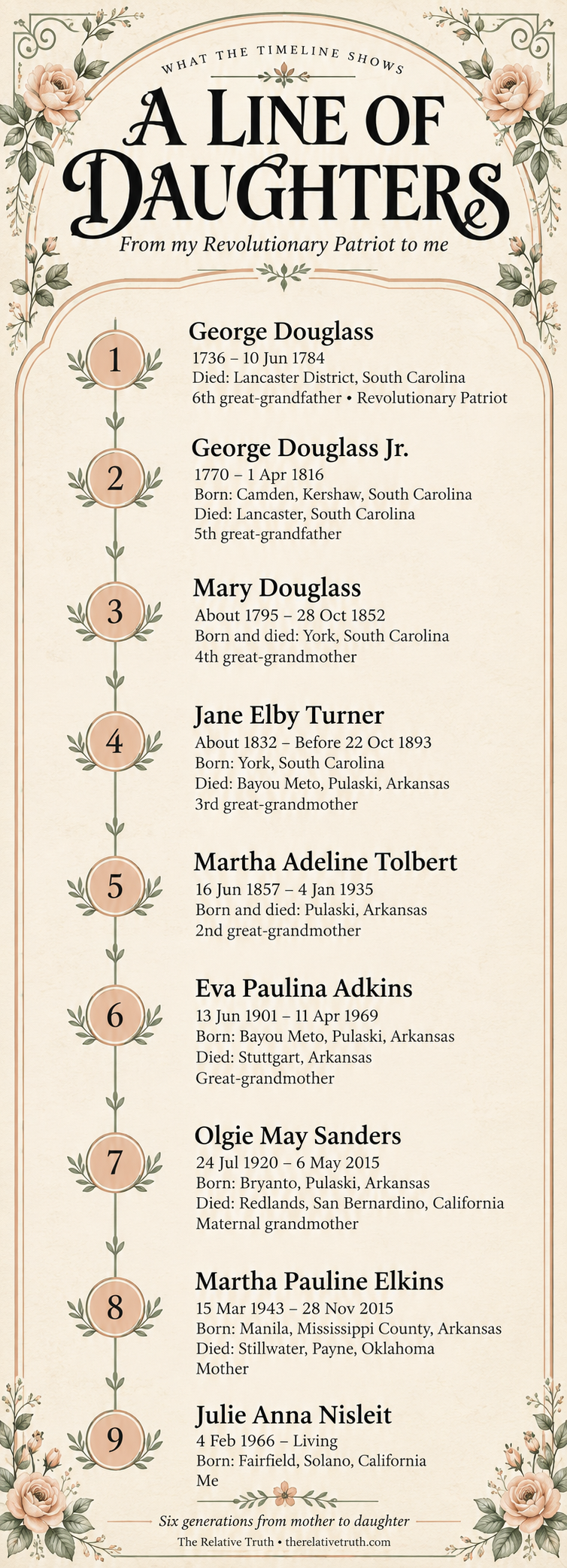
From that point forward, my path back to George Douglass passes from mother to daughter for six generations:
A line of daughters
I knew all of these relationships, of course. I've researched these women individually, entered their names and dates into my family tree, and gathered the records needed to document the generations. But seeing them together as a timeline made me notice the pattern.
For more than 170 years, this particular thread of my family passed from one woman to her daughter.
More Than Names and Dates
One of the things I enjoy most about genealogy is reaching the point where the people in my tree stop looking like only a collection of names, dates and places.
A timeline can help do that.
Jane was born before the Civil War and lived through it. Her daughter Martha was born just a few years before it began and lived into the 20th century. Eva was born in 1901. Her daughter Olgie lived from 1920 until 2015—a life that overlapped with mine for nearly fifty years.
Put those lives side by side, and suddenly the distance between the American Revolution and my own lifetime doesn't seem quite as enormous.
One Patriot, Generations of Daughters
When I joined the Daughters of the American Revolution, I had to document each generation connecting me to George Douglass. That's the nature of a lineage society: one generation at a time, one parent-child relationship at a time. The DAR application itself requires documentation of that lineal descent.
At the time, I was concentrating on proving the connections. I wasn't thinking much about what the completed chain looked like.
Now I see something different.
I see George Douglass in Revolutionary-era South Carolina. I see his son George. And then I see Mary.
Mary had Jane.
Jane had Martha.
Martha had Eva.
Eva had Olgie.
Olgie had Martha.
And Martha had me.
More than two centuries after George Douglass provided goods to support the cause of American independence, one of his descendants followed that long line of mothers and daughters back to him and became a Daughter of the American Revolution.
Sometimes a timeline shows more than when our ancestors lived. Sometimes it shows how their lives connect to our own.