A Name Carved In Stone
52 Ancestors in 52 Weeks — More Than a Name
After my father passed away, I realized how little I knew about his side of the family—or even the origins of our unusual surname: Nisleit.
What began as a simple Google search changed course in 2012, when I stumbled across photographs taken by Andrius Stanevicius in a tiny, overgrown German cemetery in Smilgiai, Lithuania. Among the weathered stones, partially hidden by moss and vegetation, was a name I knew very well.
Nisleit
The stones belonged to Mateus Nisleit and his wife, Amalija. I didn’t know who they were or how—or even if—they were related to me. But Nisleit isn’t exactly Smith or Johnson. Finding my surname carved into old gravestones halfway around the world was enough. I needed to know who they were.
— Photo: The overgrown Smilgiai German Cemetery, Lithuania. Photograph by Andrius Stanevicius. Used with permission. —
And so began what turned into a bit of an obsession. Through census records, military draft cards, obituaries, old newspaper articles, and Eastern European church records—along with more hours and dollars spent on research and German and Russian translations than I care to admit—I eventually connected Mateus and Amalija to my family in Sheboygan, Wisconsin.
They were my great-great-grandparents.
Or so I thought!
From Lithuania to Wisconsin
I eventually learned that every Nisleit I could find in the United States descended from Mateus and Amalija through four of their sons, who immigrated from Lithuania to Sheboygan between 1906 and 1912.
I researched all four brothers and built their families forward to the present day, finding photographs and stories and connecting with distant cousins. This had become about much more than collecting names and dates. I felt as though I had reclaimed a piece of my father’s family history that had nearly been lost.
The people whose names I had first seen carved into stones in a Lithuanian cemetery had become my people.
And then DNA came along.
The DNA Test That Changed Everything
As direct-to-consumer DNA testing became popular with genealogists, of course I jumped on board. But my results were strange. I had a close match I couldn’t place, and none of my DNA matches seemed to connect to the Nisleit family I had spent years researching.
At first, I wasn’t particularly worried. DNA databases were much smaller then, so surely I just needed to wait for more Nisleits to test. I contacted some of my mystery matches, but we couldn’t figure out how we were related. I actually convinced myself that perhaps they were Nisleits who just didn’t know it yet.
Eventually, I asked a known Nisleit cousin to take a DNA test. Four weeks later, his results came in.
He matched several known Nisleit relatives.
I matched none of them!
The bottom dropped out of my world. After all those years spent researching my Nisleit family, DNA was telling me something the records never could. Nisleit was unquestionably my father’s name—and mine—but it wasn’t the surname of our biological paternal line. That name was
Schultz
When I shared what I had discovered with my uncle, he remembered a man from his childhood. He was the local butcher, and the family knew him simply as “Butcher Schultz.” My uncle remembered that Butcher Schultz sometimes took him and my father out for ice cream when they were little boys.
Well. That suddenly seemed a little more interesting.
My uncle agreed to take a DNA test, and his results confirmed what my matches were already telling me: both he and my father were biological sons of Butcher Schultz, Milton William Schultz, rather than the Nisleit father who had raised them.
My biological paternal ancestors were Schultz, and their story led back to Germany rather than Lithuania. DNA had redrawn an entire branch of the family tree I had spent years constructing.
But it hadn’t erased it.
So, Who Is My Family?
That took me a little longer to understand. A beautifully documented paper trail can be completely correct and still not describe a biological relationship. Names, records, and family stories can tell us one thing; DNA can occasionally tell us something else.
The genealogist’s job isn’t necessarily to decide which story is “real.” It’s to understand both of them.
The Nisleit family raised my father. Nisleit was the name he carried throughout his life and the name he gave me. It was the name I grew up with and, eventually, the name that sent me searching for the people who came before us. DNA gave me another family to discover, but it didn’t make all those years of Nisleit research meaningless.
A beautifully documented paper trail can be completely correct and still not describe a biological relationship. Names, records, and family stories can tell us one thing; DNA can occasionally tell us something else.
Eight years after I first discovered Andrius Stanevicius’s photographs, another photographer, Greg Sevelis, returned to the cemetery and kindly took new photographs of the Nisleit graves for me. By then, I knew considerably more about the people buried there—and considerably more about myself.
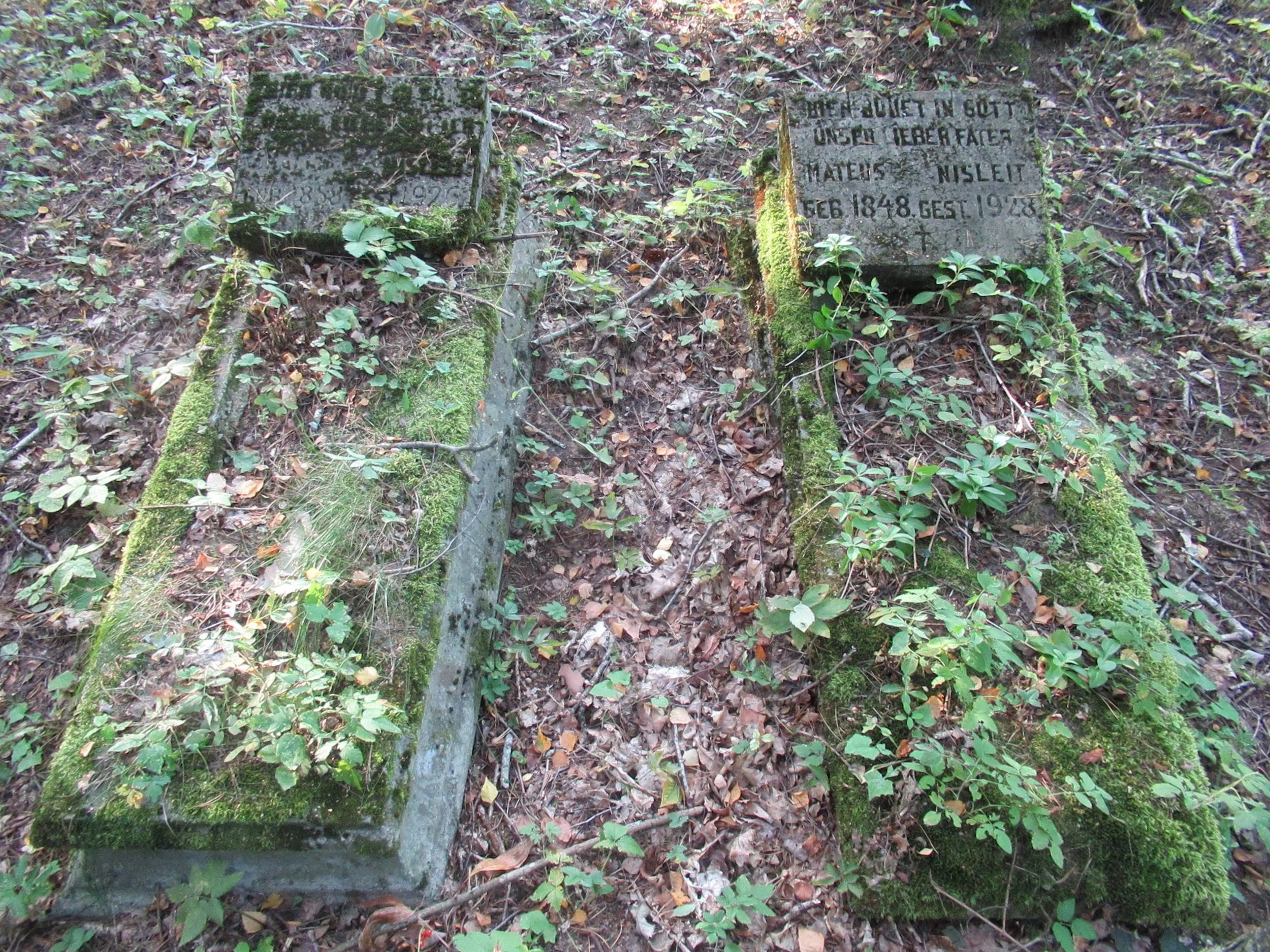
— Photo: Graves of Mateus and Amalija Nisleit, Smilgiai German Cemetery, Lithuania. Photograph by Greg Sevelis, 2020. Used with permission. —
On the gravestones, above the name that started my entire journey, is an old German inscription:
“Hier ruhet in Gott unser lieber Fater/Mutter.”
Here rests in God our dear father/mother.
Maybe that’s a fitting reminder that family has never been defined by DNA alone.
Today I can draw two paternal family trees. One follows DNA through my father to Milton William Schultz and the Schultz ancestors who came before him. The other follows the name Nisleit—through my father, through the family who raised him as their own, and eventually all the way back to that little cemetery in Lithuania where my search began.
I don’t feel the need to choose between them.
The names carved into those stones in Lithuania are no longer names I can follow through my chromosomes. But genealogy has taught me that family history is bigger than DNA. Nisleit is the name my father carried, the name he gave me, and the name that first taught me to search for the people who came before us.
DNA gave me the Schultz family. It didn’t take the Nisleits away.
They were always more than a name.